Clinical Waste Carbon Reduction Strategies for NHS Net Zero
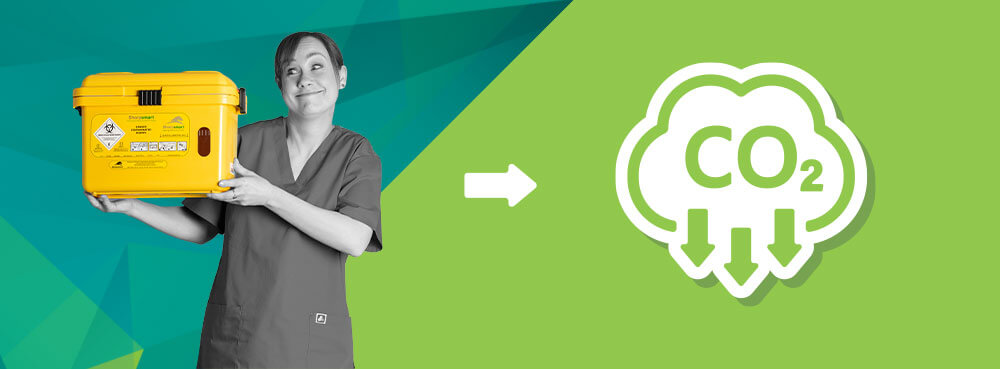
Money might not grow on trees, but low-hanging fruit for an NHS Net Zero certainly does…
NHS providers in England produce approximately 156,000 tonnes of clinical waste each year across hospitals, community settings and specialist services – a scale that makes healthcare waste management a critical lever for carbon reduction.
Waste is one of the few areas where carbon reduction can be achieved quickly, safely and cost-effectively, simply by optimising practices inside the four walls of healthcare environments.
This article explores five clinically-led strategies that support the NHS in achieving clinical waste carbon reduction on the route to Net Zero healthcare. These interventions are achievable at scale, proven in practice and deliver immediate sustainability gains.
TOPICS WE WILL COVER:
1 / Why Waste Management Is Critical for NHS Net Zero
2 / Strategy #1: Change Behaviour at the Point of Disposal
3 / Strategy #2: Maximise Compliant Container Usage
4 / Strategy #3: Reduce Reliance on Single-Use Plastics
5 / Strategy #4: Introduce or Expand Waste Streams
6 / Strategy #5: Optimise Container Placement
7 / Bonus Strategy: Implement Reusable Containers
8 / Driving NHS Net Zero From Inside the Four Walls
9 / Partner with Sharpsmart for Clinical Waste Carbon Reduction
Why Waste Management Is Critical for NHS Net Zero
The high volume of waste generated by the NHS makes it a high-impact, high-opportunity area for reducing emissions.
Every waste-related decision from the moment waste is generated influences emissions. How well you segregate waste, the types of containers used, their placement and whether you rely on single-use plastics or reusables all affect your facility’s ability to reduce the healthcare waste carbon footprint.
So, how does waste affect the NHS’s carbon footprint?
- Most carbon-intensive waste outcomes originate upstream at the point of disposal, where incorrect segregation sends material to high-carbon pathways unnecessarily.
- Inefficient container usage – such as changing containers too early – results in more collections and higher transport emissions, increasing the overall carbon impact of clinical waste.
- Heavy reliance on single-use plastics contributes significantly to clinical waste emissions, making plastic reduction a key sustainability priority.
- Inconsistent use or lack of waste streams, such as offensive waste and metal recycling, limits opportunities to divert materials into lower-carbon treatment routes and recover resources.
- Poor container placement leads to overtreatment, as staff often default to the nearest container, increasing disposal-related emissions.
- Single-use containment systems generate significant plastic waste, increasing both carbon emissions and disposal frequency.
These are just a few examples of how waste-related decisions influence carbon outcomes in healthcare environments. Now, let’s look at strategies to combat each of these challenges and reduce your facility’s CO2e output.
Strategy #1: Change Behaviour at the Point of Disposal
Waste segregation is an integral part of the NHS Clinical Waste Strategy, and the most effective way to achieve it is through behavioural change at the point of generation. This is where frontline disposal decisions determine whether waste enters the correct stream or is overclassified into costly, carbon-intensive pathways.
Common behavioural challenges include:
- Defaulting to clinical waste streams ‘just in case’.
- Disposing of non-infectious PPE into orange bags.
- Uncertainty around hospital waste bin colour coding and treatment routes.
Behaviour change is easiest when waste systems are intuitive, accessible and clearly communicated. Visual cues, consistent education, point-of-care guidance and well-designed signage help staff confidently dispose of waste the right way, without even having to think about it.
Improving disposal behaviour through waste training and education is one of the most impactful ways to support clinical waste carbon reduction across a facility.
Strategy #2: Maximise Compliant Container Usage
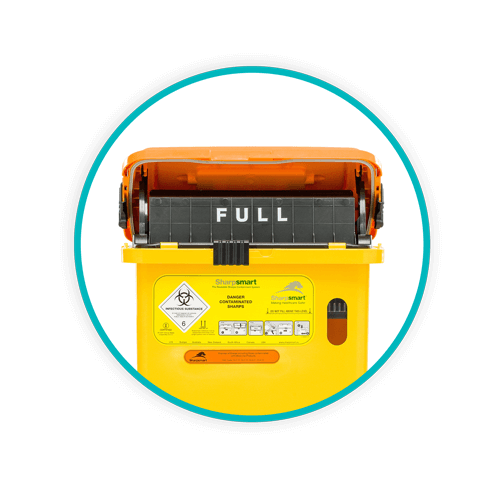
Container usage patterns significantly affect emissions. When containers are exchanged prematurely – often due to habit or perception rather than necessity – your facility’s carbon footprint increases through:
- More frequent container turns.
- Increased transport activity.
- Higher waste processing volumes.
- Additional labour demand on portering, estates and facilities teams.
Even small improvements in container usage create measurable results. The cycle of replacing half-filled containers and bags soon adds up across the many bins in the healthcare environment.
Optimising usage is one of the simplest ways to reduce emissions: ensure containers are filled to their prescribed fill line, and waste bags are filled three-quarters full.
This reduces avoidable collections, supports clinical waste carbon reduction and strengthens service efficiency.
Strategy #3: Reduce Reliance on Single-Use Plastics
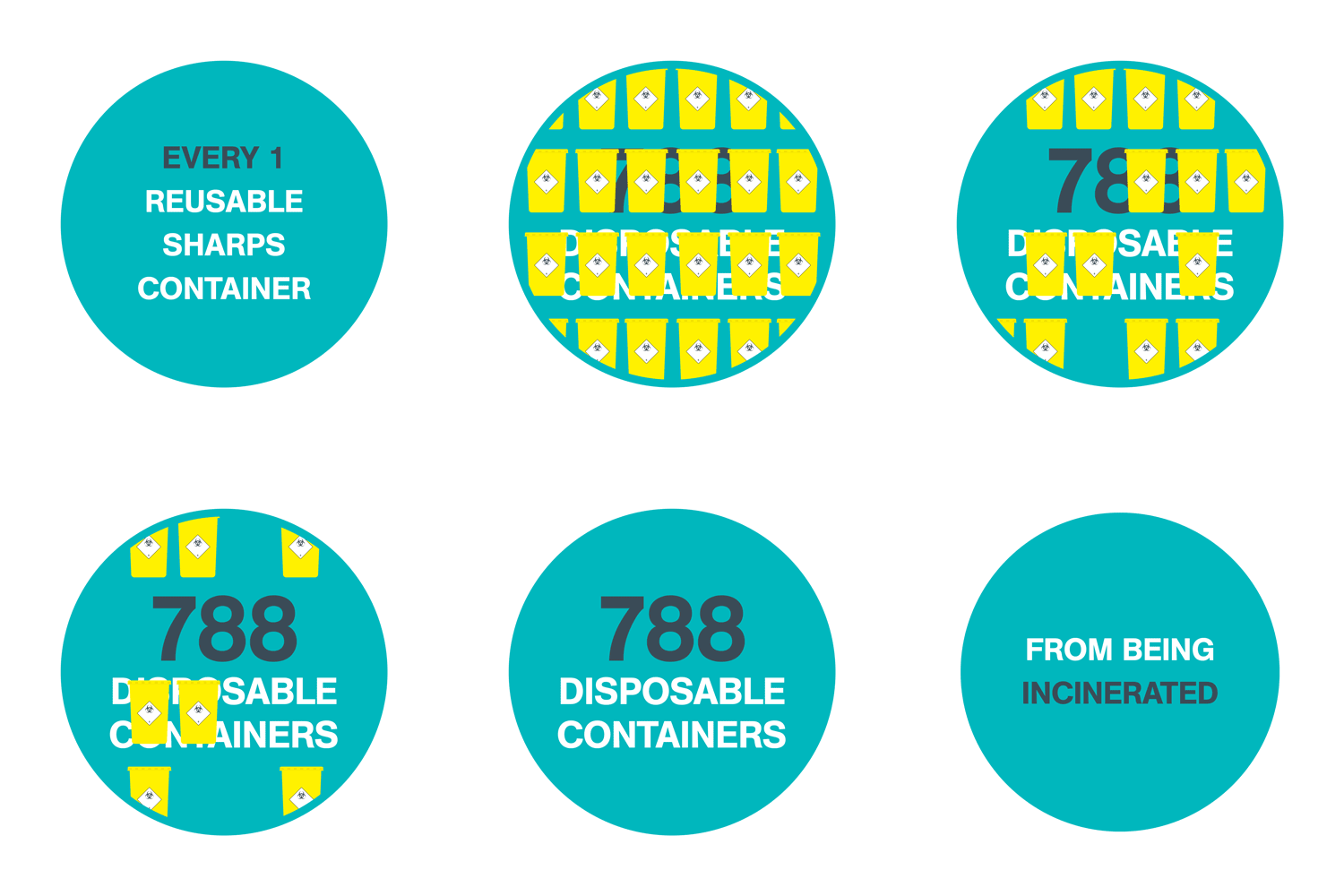
Single-use plastics remain one of the largest contributors to emissions in healthcare.
A Healthcare Without Harm study found that before the COVID-19 pandemic, 22.7% of the 11,300 tonnes of waste produced by the NHS each day was plastic – that’s around 2,500 tonnes of plastic waste daily.
As well as the numerous hidden costs of single-use plastics in healthcare, they carry a twofold burden:
- High emissions during manufacture.
- High emissions during disposal, often via High-Temperature Incineration.
Reducing reliance on disposables is a core element of sustainable healthcare waste management and one of the fastest ways to support clinical waste carbon reduction.
Wherever safe and practical, you can explore lower-carbon alternatives such as reusable equivalents, redesigned workflows, or products with reduced plastic content.
Doing so will enable you to:
- Minimise disposable consumables where safe alternatives exist.
- Reduce cardboard and plastic packaging associated with waste container supply.
- Redesign workflows to avoid unnecessary plastic items.
- Implement reusable waste containment where clinically appropriate.
- Replace disposable sharps containers with safer and more sustainable alternatives.
This result? Lower waste volumes entering High-Temperature Incineration (HTI), fewer high-carbon items procured, improved waste handling and reduced costs.
For a deeper exploration of practical steps you can take to reduce single-use plastic dependence, see our dedicated article: Single-Use Plastic Reduction Strategies for Healthcare.
Strategy #4: Introduce or Expand Waste Streams
Not all healthcare waste requires High-Temperature Incineration. In fact, HTI should make up no more than 20% of your total waste output, according to the 20-20-60 waste split outlined in the NHS Clinical Waste Strategy.
Overclassification drives unnecessary carbon emissions and removes opportunities for recycling or energy recovery.
The best way to combat this, alongside the behavioural changes required to get disposal right, is to introduce or expand waste streams such as offensive waste and metal recycling.
Typical opportunities include:
- Diverting non-infectious PPE and patient-care items into offensive waste.
- Capturing clean, single-use metal instruments for recycling.
- Using alternative treatment routes where clinically appropriate.
A quick breakdown of the carbon emissions associated with each treatment method says it all:
- High-Temperature Incineration: 901.29kg CO2e per tonne of waste treated.
- Alternative Treatment: 359.29kg CO2e per tonne of waste treated.
- Offensive Waste: 21.29kg of CO2e per tonne of waste treated.
One Trust that implemented this effectively was East and North Hertfordshire NHS Trust, diverting 61% of healthcare waste away from carbon-intensive treatment.
Strategy #5: Optimise Container Placement
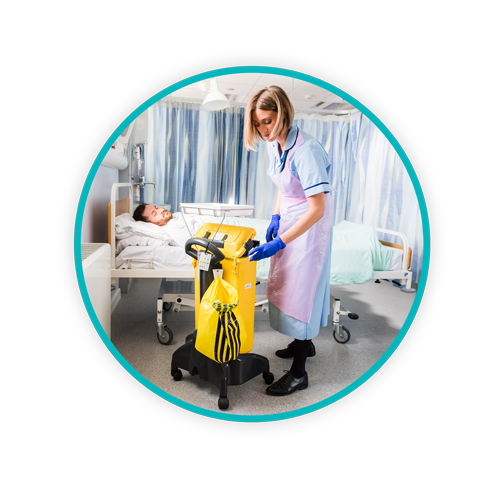
Even the best waste strategy can fail if the containers aren’t placed where clinicians need them. Poor placement is one of the most common drivers of mis-segregation.
When the correct container isn’t within reach, staff naturally default to the nearest available option – often a higher carbon stream.
On the flip side, improving bin placement in line with clinical workflow reduces these issues and enables staff to make correct disposal decisions quickly and safely. Other benefits include:
- Makes compliant segregation frictionless.
- Reduces volumes entering high-carbon waste streams.
- Improves safety and compliance with regulations and guidance.
- Supports behavioural change needed for sustainable improvement.
Royal Oldham Hospital implemented a placement optimisation strategy that saved over 120 hours of clinical staff time annually, demonstrating the operational impact of thoughtful container location.
Bonus Strategy: Implement Reusable Containers
We’ve already mentioned the importance of reducing reliance on single-use plastics, and this is our cue to speak about reusable containers. After all, they deserve a special mention as a high-impact intervention.
Reusable containment systems:
- Dramatically reduce plastic consumption.
- Minimise cardboard and packaging waste.
- Significantly lower lifecycle carbon emissions.
- Support sharps waste sustainably.
- Improve operational consistency and safety.
A peer-reviewed study conducted across 40 NHS Trusts found that annually, for every 100 beds at your facility, a switch to reusable sharps containers can:
- Reduce your carbon footprint by 11.2 tonnes of CO2e.
- Eliminate incineration of 3.1 tonnes of plastic.
- Eliminate use of 0.5 tonnes of cardboard.
- Eliminate manufacture 5,837 single-use sharps containers.
- Save 153 hours in exchanging full sharps containers.
Reusable waste containment isn’t simply an environmental intervention – it’s a clinical, operational and compliance solution.
Driving NHS Net Zero From Inside the Four Walls

Reducing the healthcare waste carbon footprint isn’t just about treatment technologies or external waste processing. The most impactful interventions start at the bedside, in theatres, in treatment rooms and across all clinical environments – everywhere waste is generated.
Behaviour, system design, container placement and daily disposal practices determine whether waste follows the lowest-carbon pathway.
Sharpsmart’s clinically designed systems, data insights, and point-of-care optimisation help healthcare organisations embed safe, sustainable and compliant practices inside the four walls.
Partner with Sharpsmart on Your Sustainability Journey
Sharpsmart partners with healthcare providers across the UK to implement clinically-led waste solutions that support NHS Net Zero waste targets and operational improvements.
We provide far more than containers and clinical waste collection; we support our partners within the four walls, transforming waste management from the inside.
If you’re looking for ways to improve your environmental impact and reach your targets on the route to Net Zero, don’t hesitate to get in touch.

Josh Glover
Let's Talk!
Your time is valuable, and we don’t want to play hard to get. You can either phone us directly on the details listed on our contact page, or feel free to fill out this short form and one of our team members will get back to you as quickly as possible.