
Over 2 Tonnes of Metal Diverted Away from HTI Annually
Case Study Overview
Discover how Liverpool Women’s Hospital has managed to divert over two tonnes of metal from incineration each year through smarter waste segregation.
A Trust Looking to Reduce the Environmental Impact of Its Waste
Liverpool Women’s University Hospital provides specialist care for women, babies, and families across Liverpool and the wider region. The hospital records over 7,500 births and around 50,000 gynaecological procedures each year, alongside its work in research and clinical innovation.
As part of the wider NHS University Hospitals of Liverpool Group, the hospital has also been looking at practical ways to reduce the environmental impact of its waste. As with any busy clinical site, the challenge was finding changes that would support sustainability without compromising its high standards of safety, compliance and operational efficiency.
Change Had to Work Around Busy Theatres and Limited Space
Like many healthcare facilities, Liverpool Women’s Hospital faced challenges in aligning waste practices with sustainability goals. Before the project began, a large amount of metal waste from clinical areas was being disposed of in yellow sharps containers. From there, it was sent for treatment via high-temperature incineration, even when the items were suitable for recycling.
This increased disposal costs and added an unnecessary carbon impact, but alternatives were available that would not only reduce disposal costs but also significantly reduce the hospital’s carbon impact.
There was also a practical side to consider. Theatres were producing much of the metal waste, but any change had to work around busy clinical routines, available space, and the need for clear segregation guidance. Staff needed to know exactly what could go into the metal recycling containers, and the system had to be simple enough to use consistently from day one, without the need for full retraining or complex process changes.
For Liverpool Women’s Hospital, the goal was straightforward – give staff a better route for recyclable metal items, reduce unnecessary incineration and support the hospital’s sustainability efforts, without over-complicating existing workflows.
A Review of Existing Streams
Sharpsmart reviewed the hospital’s existing waste streams and examined how staff disposed of metal items in practice. The audit highlighted the large volume of recyclable metals entering the sharps waste stream, particularly from Theatres.
Scoping the Most Practical Setup
Working closely with frontline teams, Sharpsmart scoped the right setup for the site, based on actual waste volumes, available space, and how Theatre teams move through their day-to-day work. The aim was to make the new system simple to use and adopt, rather than become yet another task for already busy staff.
Installation and Training
Once the system was agreed, Sharpsmart installed the metal recycling containers and delivered face-to-face training. Staff were shown what should go into the containers, what should remain in the sharps stream, and why the change mattered. Educational materials were also provided to support the rollout beyond the initial training sessions.
A Dedicated Metal Recycling Stream
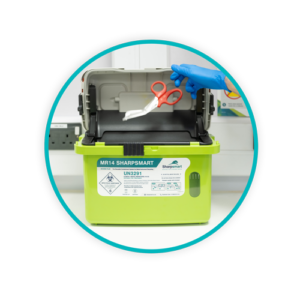
Sharpsmart introduced a dedicated metal recycling stream using reusable containment systems, focusing primarily on Theatres, the largest on-site source of metal waste.
This rollout was kept practical. Rather than simply adding another container, Sharpsmart worked with staff to ensure the system was placed where metal waste was actually being produced. This made it easier for teams to correctly separate items during their routine.
Training also played an important role. Staff were given clear guidance on which items could be recycled and how improved segregation could reduce both disposal costs and the carbon footprint.
From Zero Metal Recycling to Over 200kg per Month
Since metal recycling was introduced in 2023, Liverpool Women’s Hospital has completely transformed how metal waste is managed.
The hospital has moved from virtually zero metal recycling to consistently recycling over 200 kg per month, with some months exceeding that amount. To date, the site recycles over two tonnes of metal annually, an impressive figure for a hospital of its size.
The increase has been driven by consistent use of the new stream, particularly in Theatres. Staff now separate metal items more confidently and have a clearer understanding of how small disposal decisions can make a difference when repeated.
Staff are more engaged in waste segregation and better understand how their actions contribute to broader sustainability goals. What started as a simple operational change has evolved into a broader mindset shift towards responsible waste management.
By diverting recyclable metal away from yellow sharps containers, the hospital has reduced the amount of waste being sent for high-temperature incineration, lowering both the associated CO2e output and waste spend over time.
For Liverpool Women’s Hospital, the project shows the value of making waste segregation easier at the point of disposal. With the right containers, training and on-site support, a relatively simple change has delivered measurable progress for both sustainability and cost control.

Gabor Bozok
Let's Talk!
Your time is valuable, and we don’t want to play hard to get. You can either phone us directly on the details listed on our contact page, or feel free to fill out this short form and one of our team members will get back to you as quickly as possible.